Welcome to WAM Updates

WAM Updates are short, informal posts that put the spotlight on small, but exciting, Museum-related projects, such as the addition of a new painting or sculpture to a gallery. They also serve as updates on staff, new services or programs, and other WAM news.

We hope you like reading the Updates! If you are interested in learning about something specific, or have a suggestion for a WAM Update, please update us at wamupdates@worcesterart.org

Tuesday, July 21, 2020

The Global Influence of Blue and White Ceramics

The breadth of blue and white ceramics spans cultures and time periods. First seen in the ninth century in the Middle East, ancient Mesopotamians developed blue glazes for ceramics to imitate lapis lazuli, a highly prized bright blue semi-precious stone often used as a paint pigment.¹

Glazed blue and white ceramics were introduced to China in the Yuan dynasty (1279-1368) and later made their way to Europe by the end of the 16th century.² The blue pigment in the underglaze decoration, often cobalt oxide, was applied by brush or stenciling techniques to the ceramic prior to firing.³ While the blue and white color palette remained a constant, the type of clay, composition of the painted designs, and shape of the finished ceramics varied widely.

Pitcher with Lid, a blue and white ceramic with geometric designs, was brought to the George F. and Sybil H. Fuller Conservation Laboratory at WAM early last year (Fig.1). The lid of the pitcher was damaged and was fragmented into seven large and numerous small pieces (Fig. 2).


Fig 1. Pitcher from Pitcher with Lid. North African, Pitcher (n.d.).
Ceramic. Bequest of Mary N. Perley 1904.26.


Fig. 2. Lid from Pitcher with Lid before treatment. At the far left are the numerous
small fragments in a glass dish and at the right are the seven large pieces.


The goal of the conservation project was to restore the appearance and functionality of the ceramic lid. The surface of the ceramic was first cleaned to remove any grime. The fragments were aligned and readhered with a conservation grade acrylic adhesive.

Lastly, small losses were filled with an acrylic medium and retouched to match the sheen and color of the original glaze with dry pigments and acrylic varnishes (Figs. 3-6).


Fig. 3. Lid from Pitcher with Lid during treatment. The image shows the lid after all the
fragments were consolidated and losses were filled with acrylic media.


Fig. 4. This after-treatment image shows the lid after the acrylic media fills were in
painted to create a seamless transition to the original ceramic.


Fig. 5. Elle Friedberg, WAM Pre-Program Intern in Conservation,
in paints white fills in the repaired ceramic.


Fig. 6. Dry pigments and acrylic varnishes used for conservation treatment
are set up on a palette.


Great care was taken to ensure a seamless transition between fills and the original ceramic, making the conservator’s work nearly invisible (Fig. 7).


Fig. 7. Top view of ceramic lid after treatment.


In addition to photo documentation, a record of treatment steps and materials is always maintained by the conservator. This transparency in the conservation process is not only good practice but also may assist a future conservator or scholar who wishes to know about the history of the object. Each step in a conservation treatment is not only chosen with the integrity of the object in mind but also is fully reversible. While the repaired ceramic lid is strong and stable, with the use of specific solvents these mends can be undone, returning the lid back into its seven fragments.

While Pitcher with Lid is listed in the Museum database as North African, possibilities of a Mexican origin also have been hypothesized in the past. More art historical research needs to be conducted on this object as the cultural origin also remains unsettled and we do not have a record of the year of its creation.

—By Elle Friedberg, WAM Pre-Program Intern in Conservation, and Paula Artal-Isbrand, WAM Objects Conservator
July 21, 2020

_______________________________

1. “Blue and White Pottery.” Wikipedia. Wikimedia Foundation, June 8, 2020. https://en.wikipedia.org/wiki/Blue_and_white_pottery

2. The Editors of Encyclopaedia Britannica. “Blue-and-White Ware.” Encyclopædia Britannica. Encyclopædia Britannica, Inc., October 20, 2011. https://www.britannica.com/art/blue-and-white-ware 

3. “Blue and White Pottery.” Wikipedia.


Friday, July 17, 2020

A Masterful Manipulator of Theatricality: Greuze and French Genre Painting

In the 18th century—in the decades leading to the demise of the French monarchy, or Ancien Régime—Jean-Baptiste Greuze’s portraits and genre scenes were widely celebrated by his noble and wealthy patrons. He was born in 1725 to a master tiler who recognized his son’s artistic talent. Initially, Greuze was sent to Lyon to study portraiture. Later he went to Paris to attend the Académie royale de peinture et de sculpture (Royal Academy of Painting and Sculpture). Like many of his contemporaries, he received commissions to paint portraits. He also applied his mastery of expression to the most memorable use in his genre paintings, which employed carefully staged gestures and emotion to convey moralizing messages.


Fig. 1. Jean-Baptise Greuze (French, 1725–1805), Head of a Girl, 
18th century, red chalk on medium, slightly textured cream laid paper.
Museum Purchase, 1962.8.


Genre paintings show scenes of everyday life populated by anonymous figures, often peasants.
(Fig. 1). They were perceived as less artistically significant than “history paintings,” which portrayed subjects from the Bible or Greco-Roman mythology. Greuze attempted unsuccessfully to be accepted into the Académie royale as an officially recognized history painter in the late 1760s, despite the Académie’s concurrent enthusiasm for his genre paintings. This embittered the artist, who in turn ceased submitting his work for more than three decades to the Salon, the Académie’s annual exhibition of art in Paris.

This lack of official sanction did not, however, reduce Greuze’s popularity in a society that relished the sensibilité, or appeal to emotion, in his genre scenes, and attended private art viewings in his studio. His patrons ranged from influential Parisian collectors, like French financier and patron of the arts Ange Laurent de La Live de Jully, to Empress Catherine II of Russia.¹

Greuze painted La Geste Napolitain (The Neapolitan Gesture) while travelling in Italy with his patron Louis Gougenot, the abbé de Chezal-Benôit, who helped to promote the rising artist. The drama in this scene is conveyed through interwoven theatrical gestures, highly expressive glances, and romantic staging. (Fig. 2)


Fig. 2. Jean-Baptise Greuze (French, 1725–1805), La Geste Napolitain, 1757, oil on canvas.
Charlotte E.W. Buffington Fund, 1964.113.


In Naples, an outstretched hand with palms up (like the young woman’s right) traditionally means "Go away" or "We're closed" depending on context, while the fingers touching under her chin signify dismissal, as in “I don’t care.” While the exact meaning behind the narrative has been lost to time, the young woman’s gestures and the young man’s disguise as a peddler (only the viewer sees the medal of a nobleman, hidden from the women) suggest a moral about outward appearances. The elderly woman attempts to intervene, her gesture mirrored by the boy holding back a barking dog.

Greuze’s work became less popular as the political climate in France shifted dramatically at the end of the century. The French Revolution’s first decade of upheaval (1789-99) heralded a new style that swept the nation: neoclassicism. Lead by the younger Jacques-Louis David (French, 1748-1825), the neoclassicists championed a more austere version of history painting, in which they upheld ancient Greek philosophers and heroes from the Roman Republic as examples for the new, secular, republican regime. (Fig. 3) These figures were depicted in stark colors and crisp lineation, in dramatic stances and togas that accentuated their height—both physical and moral.


Fig. 3. Jacques-Louis David (French, 1748–1825), 
Apollo with a Cithara, about 1784, black conté crayon
on white laid paper. Stoddard Acquisition Fund, 1993.57


Greuze’s lack of success in the field of history painting spelled trouble for his survival as an artist in the French Republic. Additionally, he continued to favor the sentimental gestures and sensiblité that his Ancien Régime patrons adored, but which was spurned by neoclassicsm. It didn’t help matters that Greuze was left nearly destitute after a divorce from his wife, who purportedly embezzled his previously considerable wealth. To make quick money, he began churning out têtes de jeunes filles, studies of young women’s heads in repetitive, saccharine attitudes of devotion or ecstasy. This overflow of melodrama left contemporary critics apathetic. He died in poverty in 1805. 

In intervening centuries, interest in Greuze has waxed and waned, often dependent on modern attitudes toward genre painting, and hampered by an art historical narrative more focused on neoclassicism’s ascendancy that the decline of sensibilité. Yet whatever the dominant trends of the day may be, Greuze’s skill as a painter can’t be denied. His genre scenes display a masterful manipulation of theatricality and attention to detail and offer the viewer a fascinating look back at the morals and tastes that defined much of the 18th century.


—By Olivia J. Kiers, Curatorial Assistant
    July 17, 2020

_______________________________

1 National Gallery of Art. “Jean-Baptise Greuze.” Accessed June 17, 2020. https://www.nga.gov/collection/artist-info.1358.html 


Monday, July 13, 2020

Art and the Creation of Modern Day Paris

The city of Paris as we know it today is the product of an immense urban renewal project begun under the direction of Emperor Napoleon III in 1853. Baron Georges-Eugène Haussmann, a French administrator, was appointed Prefect of the Seine giving him carte blanche to demolish the existing Parisian landscape which had been a maze of narrow streets and buildings since the middles ages. Haussmann spent the equivalent of $1.5 billion to tear down impoverished neighborhoods, install a modern-day sewer system, create parks, build bridges, construct aqueducts, and craft the unmistakable architectural aesthetic we associate with the City of Light.

In addition to the ubiquitous five-story apartment buildings with 45-degree pitched roofs that dominate the city, Haussmann also devised long, grand boulevards in an effort to improve the movement of traffic and contain would-be rioters. These boulevards evolved into popular destinations for outdoor strolls and sidewalk cafes. This new “see and be seen” form of urban spectacle served as ongoing inspiration for contemporary artists. Several works in the Worcester Art Museum’s collection reflect the late 19th-century fascination with metropolitan living.

The Rue des Champs-Élysées was a popular destination even before Haussmann began to redesign and widen the boulevard in 1854. Then, as today, bourgeois affectations were an easy target of ridicule. Depictions of high society sauntering along the Champs-Élysées were a fixture of commercial art and fine art. In this caricature (Fig. 1), satirist Honoré Daumier presents a society couple scowling at one of Haussmann’s many construction workers whose labor disrupts their pleasant stroll.


Fig. 1. Honoré Daumier, French, 1808-1879, A pleasant stroll on the Champs-Élysées
(Une promenade d'agrement aux Champs-Elysees) Actualities #189
, 1855, lithograph,
Museum Purchase, 1953.14


The destruction of medieval Paris was controversial. Haussmann’s ambitions were costly and razing overcrowded and dilapidated buildings disproportionately displaced the poorest Parisians. Moreover, even those who appreciated Haussmann’s initiatives began to grow weary of the never-ending construction throughout the city, not unlike the ongoing debates and construction around Worcester’s Kelley Square. In 1870, at the beginning of the third phase of his urban renewal project, Napoleon relieved Haussmann of his post in an attempt to appease government opposition. The Emperor died eight months later.

It was less than a year after Haussmann was sacked that Paris entered the Belle Époque, or Beautiful Era. The Belle Époque is a period of French peace and prosperity spanning from the end of the Franco-Prussian War in 1871 to the onset of World War I in 1914. During this moment of amity, Paris saw a continued expansion of public infrastructure with an emphasis on commerce and public transportation. Turn-of-the-century culture flourished, spurring innovative art and design movements like impressionism, art nouveau, fauvism, and cubism. Belle Époque artists often used the contemporary Parisian cityscape as a way to comment on modernity.

A draughtsman and bibliophile, Pierre Vidal illustrated manuscripts for a variety of significant French writers like Honoré de Balzac and Gustave Flaubert. The color lithograph (Fig. 2) served as the dust jacket design for the book Life on the Boulevards, which Vidal co-authored with writer Octave Lebesgue (better known by his pseudonym Georges Montorgueil).


Fig. 2. Pierre Vidal, French, 1849-1929, Book Jacket for Life on the Boulevards,
published 1896, color lithograph, Sarah C. Carver Fund, 1981.291


The cover features a throng of people, dominated by women wearing large hats and tightly corseted dresses with puffed mutton sleeves. Interestingly, the women are the most prominent figures, facing the reader and rendered in color. Men are the primary subjects of the back cover, walking away in the shadow of state-of-the-art electric streetlamps, another example of Paris’s modern-day infrastructure.

Public transportation exploded across Paris in the mid-19th century. One of the first forms of public transport was the horse-drawn omnibus, a low-tech version of a double decker bus. Later omnibuses were propelled by steam locomotion in the form of tramways. In July 1900, Paris debuted its Metro or Metropolitan subway. It opened with just one line across the right bank. By 1913 there were eight lines across the city.

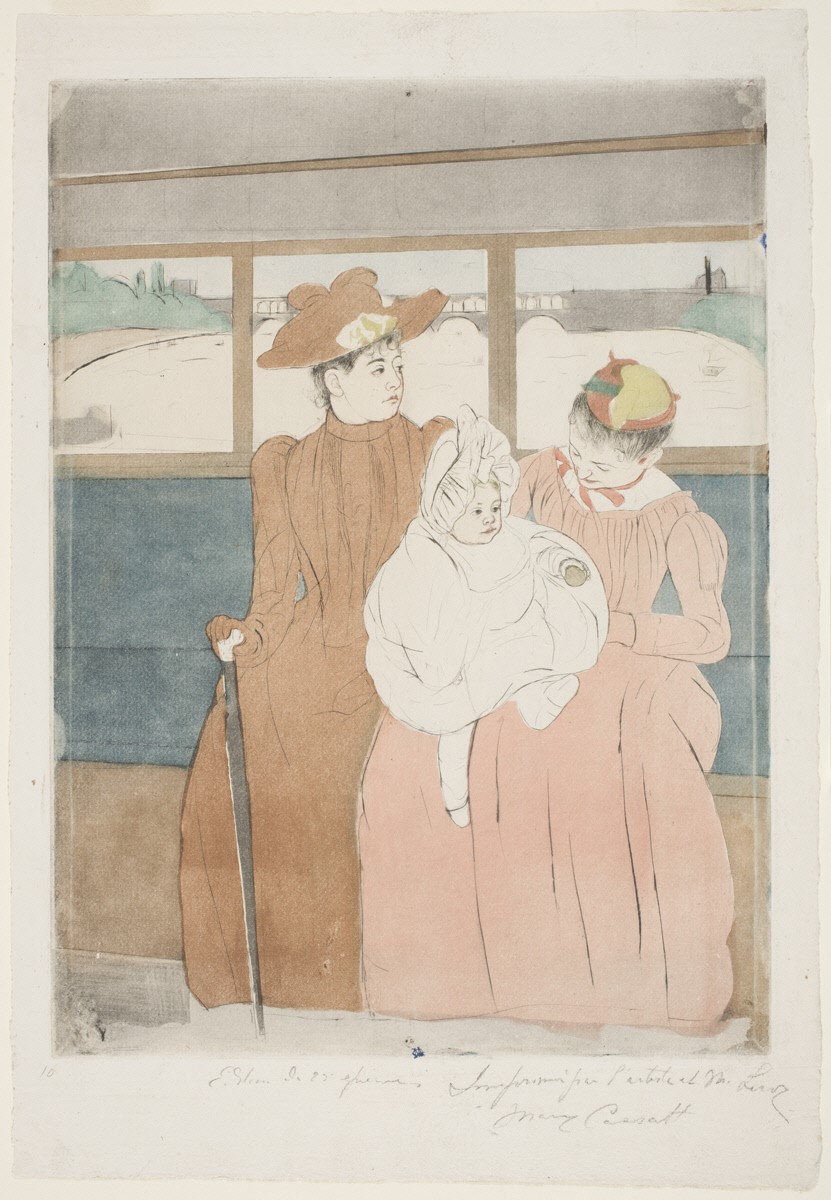
Among a celebrated group of color aquatints Impressionist artist Mary Cassatt made in 1891, On the Omnibus presents a cosmopolitan mother alongside her child and nanny. Though the title refers to the more antiquated omnibus, it is more likely that Cassatt’s subjects are seated on a tramway.

In a preparatory drawing for the print, Cassatt included a male figure in a top hat who was excised from the finished work. (Fig. 3) Her decision to remove him is significant in that the final work emphasizes that the women are unaccompanied by a chaperone; however, tramways were usually jampacked. (Fig. 4a) In order to focus attention on the women in her print, Cassatt sacrificed the physical density one found on Parisian public transport. (Fig. 4b)


Fig. 3. Mary Cassatt, American, active France, 1844-1926,
Preparatory drawing for 
On the Omnibus [recto], c. 1891,
black chalk and graphite on wove paper, Rosenwald Collection,
National Gallery of Art, Washington D.C., 1948.11.51.a


Fig. 4a. Mary Cassatt, American, active France, 1844-1926, On the Omnibus (The Tramway), 1891, aquatint, softground etching,
and drypoint, Mrs. Kingsmill Marrs Collection, 1926.204


Fig. 4b. Mary Cassatt, American, active France, 1844-1926, On the Omnibus (The Tramway),
(detail), 1891, aquatint, softground etching, and drypoint, Mrs. Kingsmill Marrs Collection, 1926.204


French film and cultural historian Roland-François Lack meticulously mapped where Cassatt staged her tramway print. Based on his research, the women were crossing the Pont de Grenelle which was built in 1874 and accommodated trams. The bridge seen behind Cassatt’s figures is the Pont de Pont du Jour, built in 1865. (Fig. 5)  To the right of the bridge, Cassatt offers a nod to Parisian industrialization with the small detail of smoke billowing out of the smokestack on the horizon.


Fig. 5. The bridge seen behind Cassatt’s figures is the Pont de Grenelle, built in 1865.


Cassatt’s print was made the same year Haussmann died. Though he never lived to see it, his vision for a new Paris was fittingly completed in 1927 with the inauguration of Boulevard Haussmann.
(Fig. 6)


Fig. 6. A view of Pont de Pont du Jour .


—By Nancy Kathryn Burns, Stoddard Associate Curator of Prints, Drawings, and Photographs
    July 14, 2020


Tuesday, July 7, 2020

Illustrating the Nuremberg Chronicle

The Nuremberg Chronicle was an encyclopedic history of the world and Christianity that spanned seven ages of man. The seven ages begin with creation, then ages two through five detail the events leading to the birth of Christ. The sixth age is the largest portion of the book and covers major world events up to its publication before ending with the seventh age, end times and Judgment Day.

The pages shown here are pulled from the book Liber Chronicarum by Hartmann Schedel. More commonly known as the Nuremberg Chronicle, it was first published in Latin in 1493 with a German edition appearing soon after.

Today the Chronicle is regarded as one of the earliest European books to successfully incorporate text from movable type and printed images. Altogether the Chronicle contains 1,809 illustrations printed from 645 different woodblocks. It was an undertaking of monumental proportions. A surviving bookseller’s advertisement bound into Schedel’s personal copy of the book promises:

“...so great a delight in reading it that you will think that you are not reading a series of stories, but looking at them with your own eyes. For you will see not only portraits of emperors, popes, philosophers, poets and other famous men, each shown in the proper dress of his time, but also views of the most famous cities and places throughout Europe, as each one rose, prospered, and continued.”

The marriage of text and image afforded readers an opportunity to envision distant lands long before photographs and commercial flights.

The illustrations are relief prints created from carved woodblocks. The task of designing these blocks was assigned to the largest workshop in the city of Nuremberg, that of Michael Wolgemut. He was one of the leading artists of German woodcuts and is well-known today as the teacher of the artist Albrecht Durer.

Durer was an apprentice in Wolgemut’s workshop in the years leading to the publication of the Chronicle from 1486 until roughly 1490. Though none of the blocks in the Chronicle are signed, it is likely that Durer was involved in the creation of some of the Chronicle’s woodblocks. While he is best known for his engravings, Durer’s use of woodblocks and biblical themes continued outside of his apprenticeship. WAM’s 1497 impression of Durer’s Samson Rending the Lion (Fig. 1) depicts a biblical tale set against a pastoral backdrop. It includes a distant cityscape reminiscent of those found in the Chronicle.


Fig. 1. Albrecht Dürer (German, 1471–1528), Samson Rending the Lion,
 1497, woodcut on white laid paper. Museum Purchase, 1935.152


WAM’s permanent collection includes three illustrated pages from the Chronicle. Two depict creation from the first age of man and one depicts a line of Italian kings from the sixth age. WAM’s impression of God the Father Enthroned is especially notable given it is a hand colored full-page illustration (Fig. 2). It is also one of the first images in the Chronicle. Woodblock prints were typically only printed in black ink, but wealthier customers would often commission an artist to add color.


Fig. 2. Michael Wolgemut (German, 1434–1519), Wilhelm
Pleydenwurff (German, 15th century), 
God the Father
Enthroned, from the Nuremberg Chronicle (fol. 1),
 1493,
woodcut on cream laid paper with hand coloring,
Theodore T. and Mary G. Ellis Fund, 2002.522


Until the invention of Johannes Gutenberg’s printing press around 1440, books in Europe were copied out by hand and manuscript culture had not been forgotten by the 1490s. Hand coloring harkens back to the tradition of illuminated manuscripts when an artist outside the print shop, enhanced printed images using watercolor or an aqueous-based paint. The two remaining pages are fine examples of the marriage of imagery and text that brought the book to life. The image of God creating Eve from Adam’s flesh vividly interprets the biblical text. (Fig. 3)


Fig. 3. Workshop of Michael Wolgemut (German, 1434–
1519), T
he Creation of Eve, from the Nuremberg Chronicle
(fol. 6)
, 1493, woodcut on cream laid paper.
Harriet B. Bancroft Fund,1980.36


Moreover, WAM’s page depicting a royal bloodline epitomizes what makes the Chronicle so unique. (Fig. 4) Instead of merely formatting the movable type at the top of the page and positioning a woodblock beneath as was typical, here the text is sandwiched vertically between the two long columns of woodblocks, which themselves contain carved text.


Fig. 4. Workshop of Michael Wolgemut, Michael Wolgemut
(German, 1434–1519), 
Folio 52 from Nuremberg Chronicle,
1493, woodcut on cream laid paper. Mrs. Kingsmill Marrs
Collection: 1926.1642


As such, the content and illustrations are closely interwoven. Breaks in the borders on the woodblock column at left and in the central vine demonstrate that this was a composite image made from several smaller woodblocks that had been fitted together, making the layout of the page especially challenging to assemble and print.

—By Gabrielle Belisle, Fellow for Prints, Drawings, and Photographs
    July 7, 2020


Thursday, July 2, 2020

Mapping the “New World”

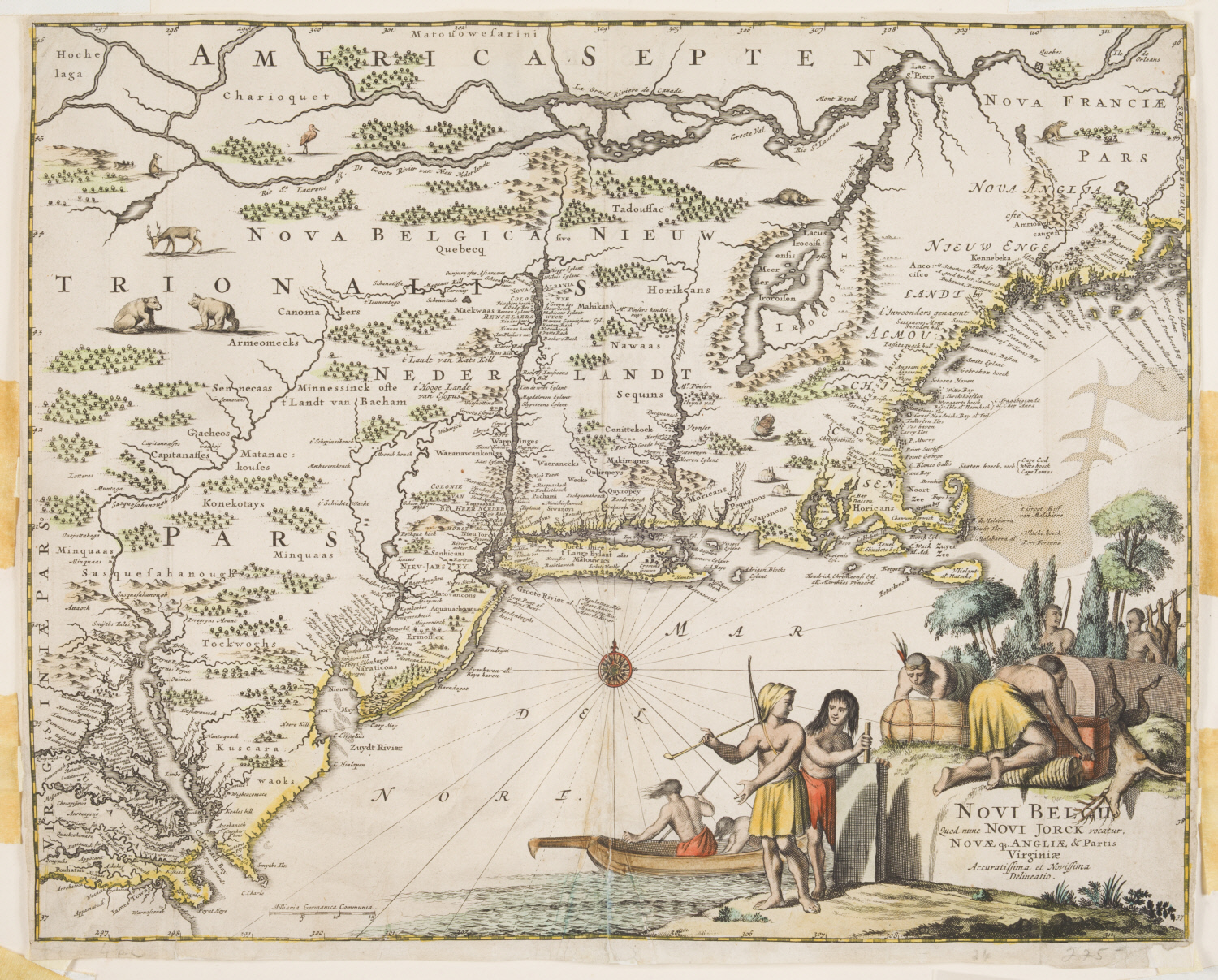
Across browning edges and intertwining mountain ranges, an inscription proclaims “Americasepten” (North America in Latin) on the top of the Map of American Eastern Seaboard from Chesapeake Bay to Penobscot Bay, within the Worcester Art Museum’s map collection. Illustrated with regional trees, livestock, and riverways, the artistic value of the historical map is anything but lost.


Fig. 1. John Ogilby (Scottish, 1600–1676) and Arnoldus Montanus (Dutch, about 1625–about 1683), After Map of American Eastern Seaboard from Chesapeake Bay to Penobscot Bay, after 1670,
engraving with stipple engraving and hand coloring on paper.
Bequest of Robert Dudley Harrington Revocable Trust, 2017.82


Scottish translator and cartographer John Ogilby’s map of the North American coastline from Chesapeake Bay to Penobscot Bay (Fig. 1) is a result of an early translation of Arnoldus Montanus’ mapmaking in Amsterdam, as well as evidence of early historical cartography. Montanus’ work is considered “the first encyclopedia of the Americas.”1

Originally published in 1671 in Amsterdam, De Niewe en Onbekende Weereld: of Beschryving Van America en ‘t Zuid-Land was Montnanus’ fullest body of work, compiling maps of the entirety of North and South America, containing colonial versions of maps as well as illustrations of New York (titled “New Amsterdam”), Brazil, and portraits of early explorers and colonizers, such as Christopher Columbus. This encyclopedia, translated into English by John Ogilby, provides a window into one of the earliest informative texts on the “New World” that was disseminated throughout Europe, and then throughout the Americas.2

In addition to the portraits of colonial men, most maps feature a title cartouche—a cartographical feature with elaborate decorations which add a symbolic narrative. As seen in this map in WAM's collection, the nature of colonial map’s cartouches were often depictions of Native Americans as a kind of “proof” of the explorer’s conquest.3

Here, Native Americans in the lower corner are seen working, tending to fishing, archery, or a hunted deer. Beneath their depiction inscribes a European claim to the land, titling it “Novii Belgii” —New Belgium. Both the artistry of the cartouche and its territorial claim are evidence that a map is far more than a means of seeing locations on a piece of paper.

Ogilby’s map differs greatly from any brochure map one would use today on a road trip or hike. In the 1600s, maps were rarely used as a method to route from one place to another and were rather used as a method of cutting up the world, and laying claim to it.4; Cartography in its early stages reflected conceptually the culture where the map was made; early European maps made by Christians often situated Jerusalem at the heart of the continent.5

These symbolic maps engaged the artistry of cartographers, who occasionally commissioned an artist to help decorate the published maps. Maps, therefore, are not exclusively geographical, but are also artistic and political in their appearance, and moreover, in their interpretation.

European maps were utilized as a form of control over political and public perception in the 16th-18th centuries to sway public opinion regarding colonial expeditions. This motivation for cartographers has not been lost as mapmaking evolves, but has morphed to alter the perception of world powers in education. The distortion of maps plastered in school classrooms has been a topical debate; the Mercator projection—the most widely used map perspective in the U.S.—positions North America in the center of the map, and distorts the size of the African and Asian continents, as well as misleads its viewer on the size of the Pacific Ocean (considerably larger than the Atlantic).6

The debate of map perspective and its related impact is what led Boston Public Schools to adopt a new projection that reduces the size of European and American countries to their actual size in comparison to the rest of the world.7

Ogilby’s map reminds its viewer of the important role which all published works—art, encyclopedias, maps—play in enforcing cultural ideas and altering public perception.

—Skylar Deitch, Curatorial Intern
    July 2, 2020

------------------------------------------------------------
1 D. Woodward, The Papers of the Bibliographical Society of America, 516.
2 It is important to note that at the time, maps and other materials were not nearly as widely published as they are today; only the wealthiest and elite would have had access to such texts. Matthew Edney, “Theoretical Aspects of the History of Cartography,” Theory and the History of Cartography, 48, no. 1 (1996): 188.
3 Woodward, 520.
4 Ibid., 519.
5 Edney, 192.
6 Norman Pye, “Notes on Some Problems in Presentation of Map Projections,” Geography 34, no. 2 (1949): 69.
7 Joanna Walters “Boston Public Schools Map Switch Aims to Amend 500 years of Distortion,” The Guardian, (2017): https://www.theguardian.com/education/2017/m ar/19/boston-public-schools-world-map-mercator-peters-projection?CMP=share_btn_link
https://www.theguardian.com/education/2017/m ar/19/boston-public-schools-world-map-mercator-peters-projection?CMP=share_btn_link

Tuesday, June 30, 2020

Rediscovering Objects at WAM: A Study in Silver

As a decorative arts specialist, I utilize a hands-on approach when studying objects. This process doesn’t merely involve sitting in an archive for hours, combing through old letters and documents. Rather, evaluating an object involves looking at its physical and aesthetic qualities (i.e., material, form, style, ornament, markings).  To me, the object itself can unlock hidden clues that reveal its actual story. During my first year at the Worcester Art Museum, I found myself investigating what I thought was a plain, ordinary silver vessel (Fig. 1). But I soon realized there was more than initially met the eye, as it were…


Fig. 1. Harris, Stanwood & Co. (American, active 1839-1848). Covered Pitcher, about 1839-1848. Silver. Gift of the
Paine Charitable Trust, 1965.326.


Until May 2019, the silver object was given another attribution. While viewing WAM’s decorative arts online, I noticed it was cataloged as a chocolate pot, made circa 1820-1830 by “Ferris & Starr.” Unable to find any silversmith firms or jewelers with that name, I decided to investigate the object and its history more closely.

I recalled learning about chocolate pots while taking a graduate course on the decorative arts of dining at George Washington University. Most 17th- and 18th-century examples were made of silver or porcelain, two valuable materials that associated chocolate—made of cacao beans, an exotic import from Mesoamerica— with Western luxury.

These vessels contain a lid and hinged finial, with a small opening to accommodate a molinet, the utensil used to stir the liquid chocolate. Silver chocolate pots typically include a thick wooden handle to withstand heat; indeed, one could say chocolate pots were “hot” commodities! However, this object didn’t seem to possess any of these characteristics. Thus, I pulled it from storage to view it in person, hopeful that my questions would be answered and theories validated. As a result, I found a maker’s mark hidden underneath the base, stamped “Harris & Stanwood, Pure Coin Silver, Boston.” (Fig. 2)


Fig. 2. Detail of mark underneath pitcher's base.


First appearing in the 1839 Boston directory, Harris, Stanwood & Co. was one of Boston’s distinguished jewelry houses and silver manufacturers in the early 19th century. (Figs. 3-4) Its founders William Harris and Henry B. Stanwood retailed a variety of goods at low prices, including: “Silver and Plated Wares, Watches, Clocks, Lamps, Gas Fixtures, Candelabras, Tea Trays, Fine Table Cutlery, Rich Fancy Goods, & Watches and Clocks cleaned and repaired by an experienced workman.”¹ The firm even experimented with types of oil in solar argand lamps.²


Fig. 3. Illustration of interior in H.B. Stanwood & Co., from Gleason's Pictorial Drawing-Room
Companion 
(Boston, MA), July 23, 1853, pg. 64. Stanwood operated his own firm shortly after
Harris retired in 1848. He later joined his rival Shreve, Brown & Co., which became
Shreve, Stanwood & Co. in 1861.


Fig. 4. Advertisement from the Boston Courier (January 7, 1839).


When Harris retired in 1848, the firm changed hands and eventually reorganized to become the familiar Shreve, Crump & Low establishment. After finding examples of Harris & Stanwood silver at other New England institutions, I contacted Patricia Kane, the curator of American decorative arts at Yale University Art Gallery, to determine the object’s true identity. She confirmed my suspicions: it wasn’t a chocolate pot, but actually a covered pitcher!

More questions arose since reattributing this object. For instance, according to Kane, pitchers from 1800-1850 were made with and without covers. So, why do some have covers? One theory is that this Harris & Stanwood pitcher would have held water, wine, or beer—like flagons in church communion services.

On the other hand, it may have possessed a commemorative purpose as a presentation object. In December 1840, Harris and Stanwood created a pitcher for the Massachusetts Horticultural Society, to be awarded to its president Elijah Vose. One newspaper described it as “a specimen of exquisite workmanship…embellished with grapes, vines, and other appropriate emblems, beautifully chased, and highly finished.”³ However, the lack of chased decoration in this pitcher indicates its use as a container for liquid beverages, though it probably decorated the table.

Additional research is ongoing regarding the pitcher’s owner, whose identity is hinted by the engraved coat of arms and inscription “E S to James Perkins Paine.” (Fig. 5) Based on my initial findings, James Perkins Paine (1827-1910) was the descendant of Russell Sturgis and William Paine, whose silver service by Paul Revere is displayed at WAM. If he is related to Worcester’s Paine family, then the “E S” likely refers to Elizabeth “Betsy” Perkins Sturgis (1756-1843), his aunt who lived in Boston—and quite possibly near Harris and Stanwood’s firm!


Fig. 5. Detail of engraved inscription and coat of arms.


My investigation into the Harris & Stanwood pitcher demonstrates how there are still mysteries to be solved, and stories to be unveiled at the Worcester Art Museum. Our decorative arts, in particular, need extensive research, analysis, and cataloging. About 2,664 objects encompass WAM’s American decorative arts collection, yet many remain in storage or lack a complete provenance or other valuable information.

This illustrates the fact that before the 20th century, art historians considered the decorative arts secondary to fine art paintings and sculpture. While WAM’s former American curator Louis Dresser significantly acquired and researched Paul Revere silver during the 1960s, her successors made little efforts to showcase the decorative arts. By placing objects first, museums can tell the full story of a period, culture, and community.

Beginning Fall 2021, WAM will integrate the fine and decorative arts in its American galleries, a project funded by the Henry Luce Foundation (titled Conspicuous Consumption: The Price of Luxury in Early America). In doing so, I hope visitors can learn and appreciate the intrinsic value of early American objects like this covered pitcher.


—By Elizabeth Fox, Curatorial Assistant of American Art
     June 30, 2020
------------------------------------------------------------

1 1847-8 Adams’s Boston Directory
2 Referenced in "To the Public," Atlas (Boston, Massachusetts), December 15, 1842. Harris and Stanwood inspected numerous whale oils, rating them based on cost and ability to produce artificial light.
3 National Aegis (Worcester, Massachusetts), December 30, 1840.


Friday, June 19, 2020

Spotlight on the Sport of Jousting and its Decline

The sport of jousting was a single combat between two knights using the couched lance against each other, charging from opposite ends of a tournament field. Before the 14th century, the melee was the main tournament event, with jousting as a secondary game. Jousting matches were held as a prelude to the melee. Knights wanted to be recognized as individuals in combat and spectators enjoyed the individual contests. By the 14th century, Jousting would supplant the melee as the main sport in popularity and by the end of the century the melee would all but disappear.


Fig. 1. The Third Tournament with Lances, Lucas Cranach the Elder (German, 1472–1553),
1509. Woodcut on cream laid paper. Prints. Museum Purchase. 1935.153


Jousting was played in rounds called courses. Typically, three courses were run with the lance and the fighting might continue dismounted with courses of swords, axes and daggers. Scoring was sometimes done by awarding points for striking an opponent and breaking the lance, or for dismounting him, the latter could decide the match. Different points could be awarded for striking different body locations.

With the development of plate armor in the 1300s-1400s, specialized tournament armor came into use (Fig. 2). Reinforced pieces could be attached to an existing armor strengthening it. These were called pieces of advance, or exchange, or simply reinforces and would be bolted on to the armor.
A feature added to the joust around the late 14th century was the tilt barrier. The tilt barrier was initially a rope barrier draped with fabric and later a wall that separated the jousters to keep the horses from colliding, allowing the knights to be able to better control the horse and aim their lances.


Fig. 2. Composite Armor for the Welschgestech ("Italian Joust"),
breastplate by Anton Peffenhauser (Southern Germany (Augsburg),
ca. 1520 – 1603), other components Southern German, Augsburg, or Italian.
1570–1575. Steel, brass and leather with modern restorations.
 The John Woodman Higgins Armory Collection. 2014.1142


The most common form of jousting was the Joust of Peace. It was focused on being a chivalric contest of skill with lances and swords which were blunted, or rebated, to minimize injury. The lance tip could take the form of a three-pointed coronel (Fig. 3) designed to aid the lance in shearing off armor as well as to break it. The idea was to fairly defeat the opposing knight but not to cause injury. Honor, humility, and fairness were now of greater importance as the combat was to be one of skill not guile.


Fig. 3. Tournament Lance with Coronel Tip, German, perhaps Dresden. 1500s or 1700s.
Painted wood with steel. The John Woodman Higgins Armory Collection. 2014.269


In the 15th century a popular type of jousting was the Passage of Arms. In this game a knight or group of knights would set themselves up at a bridge or city gate and challenge all who passed by to joust. They would announce their intentions to hold their ground for a set period or some other goal achieved, such as the breaking of several lances. Failure of a passing knight to meet the challenge could lead to social humiliation and forfeiture of their horse or armor. These were challenges of honor being less formal and of a smaller scale than tournaments and there were few spectators.

The Joust of War was a variant where knights who were at war competed with each other. The combatants used the regular armor and weapons of war. While they could be deadly, the use of plate armor reduced the chances of injury compared to those of former days. It was a chance to demonstrate chivalric pride in the face of the enemy.

A particularly German form of the joust was the Stechzeug. This variant featured heavy body armor (Fig. 4a). The goal of game was to knock off an opponent’s helmet crest. With blows concentrated at the head a thick heavy helmet was needed. Evidence of the force used can be seen with the multiple scars left from lance cornel tips that struck surface of the helmet depicted below (Fig. 4b).


Fig. 4a. Composite Stechzeug (armor for the "German Joust"),
pauldrons by Valentin Siebenbürger (German, 1510–1564),
others Southern German, from Nuremberg. About 1480–1540.
Steel, iron, brass and leather. The John Woodman Higgins
Armory Collection. 2014.1164


Fig. 4b. Stechhelm (Jousting helmet), Southern German,
Nuremberg. Late 1400s. Steel, iron and brass.
The John Woodman Higgins Armory Collection. 2014.1164.1


Combat at the Barriers (Fig. 5a) was a form of dismounted jousting that knights would play during sieges and was an outgrowth of the Joust of War. Waist-high barriers were placed between the besieged and besiegers. Combat would use various weapons such as the longsword or the poll-axe.


Fig. 5a. Combat à la barrière (Combat at the Barriers), Jacques Callot (French, 1592–1635),
1627. Etching on cream laid paper. Prints. Museum purchase. 1953.7


Gradually this contest became a regular tournament sport practiced outside of war. Heavier armors were used to minimize serious hits as evidenced in the sword marks visible on the helmet below (Fig. 5b). 


Fig. 5b. Close Helmet for Foot Combat at the Barriers, Italian, probably Milan. About 1600.
Steel and brass. The John Woodman Higgins Armory Collection. 2014.1156.1


From the 14th century onwards tournaments would become ever more frequently sponsored by royalty, something unthinkable in the past. While declining in the early 15th century with the decline of battlefield chivalry, the late 15th and early 16th centuries would see a huge rebound. Sovereigns such as Emperor Maximillian I and his contemporaries, Henry VIII and Francis I, celebrated chivalry at court, romanticizing it with huge, elaborate tournaments. But this did not survive much past their generation.

The mid-16th century would see the general disappearance of large tournaments. By the 17th century tournaments were more for royal prestige being semi-martial displays of horsemanship. Most involved parading and fancy maneuvers. Jousting was now theatrical and formulaic as direct contact with lances was gradually replaced by the Carousel or Tilting at the Ring (Fig. 6).


Fig. 6. Lance for "Tilting at the Ring", probably German, 1650–1750. Painted wood
(partially restored) with steel. The John Woodman Higgins Armory Collection. 2014.261


The carousel involved riding around a circuit and catching rings on the end the lance, an exercise that had long been done by knights for practice. With no contact there was less risk and less reason for armor to be worn beyond display. By the late 17th century as the reality of armored cavalry on the battlefield faded away so too did tournaments.

We hope you enjoyed the second part of this look at the fascinating and complex history of knightly competitive pursuits.

—By Neal Bourbeau, Programming Coordinator
     June 20, 2020


Recent WAM Updates